






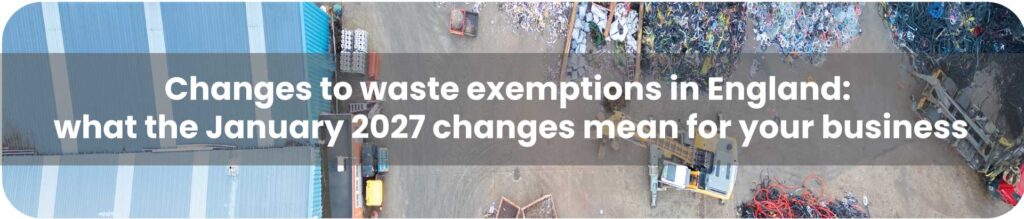
The waste exemption regime in England is set for its biggest overhaul in years, with new rules now expected to come into force on 6th January 2027. On 21st October 2026, the Environment Agency published guidance (opens in a new tab) setting out what will change, who will be affected and when they will need to comply.
The reforms are still going through Parliament and are expected to be approved before 17th December 2026.
What is changing
It is likely that almost every exemption holder in England will be affected in some way. For most, the changes will be minor and include slight changes in wording. For others, it will mean applying for an environmental permit, varying an existing one, or stopping an activity altogether.
The guidance highlights five key areas of change. Some apply immediately from 6th January 2027, others come with a transition period.
- Three exemptions are being withdrawn. T8 (mechanically treating end-of-life tyres), T9 (recovering scrap metal) and U16 (using depolluted end-of-life vehicles for parts) will be withdrawn on 6th April 2027. Anyone using these exemptions will need to apply for an environmental permit or stop the activity from this date. (Operators who apply for a permit before 6th April 2027 will be able to continue working under the exemption while the application is processed).
- Exemptions ‘technically connected’ to a permitted activity will no longer be allowed Where an exemption applies to, or is next to, a permitted site and could increase the overall environmental risk of that site, it must be brought into the permit conditions by 6th July 2027, or the exempt activity must stop.
- Multiple exemptions at one site will have reduced storage capacities. From 6th July 2027, where a site has more than one exemption covering the same waste type, the storage limit for that waste will be the lowest limit among those exemptions. For example, if two exemptions allow 500 tonnes of plastic and a third allows 300 tonnes, a combined limit of 300 tonnes is permitted, not 1300 tonnes.
- Some regulatory positions are being replaced. Certain regulatory positions are being superseded by changes to the exemptions themselves. Details on which regulatory positions will no longer apply have not yet been announced. Operators who rely on regulatory positions for waste activities will therefore need to check regularly to see if the regulatory positions used have been affected. We will keep you updated via the relevant entry in your legal register, Regulatory Position Statements – England. (opens in a new tab)
- Two non-waste framework directive (NWFD) exemptions will have waste storage limits increased. Storage limits under NWFD 3 (temporary storage of waste produced elsewhere) (opens in a new tab) and NWFD 4 (temporary storage at a collection point) (opens in a new tab) will increase. The revised limits are yet to be published.
Key dates and transition periods
Most minor changes take effect on 6th January 2027. More complex changes will carry a 3, 6 or 12 month transition period. Therefore, organisations holding several exemptions may face different deadlines for each.
New tutor-led online course
Key changes to waste exemptions
To help you and your team prepare for the changes, we have developed a Key Changes to Waste Exemptions online course. This interactive course has been developed by our team of expert consultants to guide you through the reforms. It gives practical advice to help you work out which changes affect your organisation, when they apply, and how to prepare.
Online, tutor-led · Half-day sessions from January 2027 · £295 + VAT per attendee
Covers exemptions registered in England only. The course is subject to the reforms being approved by Parliament.